There’s an old cartoon that shows a man seeing a doctor and telling him, “It hurts when I move my arm like this.” And, the doctor replies, “Then quit moving your arm like that.”
Jokes aside, the body has certain ways of telling us that something is wrong. If your knee aches for a period of time, a cause exists (perhaps a disc that’s wearing down). If your stomach hurts, you probably ate something that disagreed with you. A lower back ache may be due to strained muscles, perhaps during a rigorous workout or lifting something heavy.
Understanding TMJ Disorder
As a general dentist serving patients in Oakland and Macomb counties, treating toothaches is a large part of my day. The reason for most toothaches is typically some level of decay or infection that has formed below or within the tooth. These can typically be treated with a filling or crown over the tooth once the tooth is free of decay or the infection has been resolved.
I also treat patients whose pain starts in the jaw and spreads beyond the mouth.
Many individuals are surprised to learn that their persistent headaches, vertigo, or ear ringing can be linked to jaw joints that have become stressed and strained over the years. These joints, known as the temporomandibular joints (or TMJ), are located in front of the ears on each side of the head. These joints hinge the lower jaw to the skull – and move often.
When certain issues create strain on the movement of the joints as they rotate in unison, there are eventually warning signs that signal the brain that something is wrong. This comes in the form of pain or symptoms that cause aches, soreness or imbalance.
Common Causes and Symptoms of TMJ Disorders
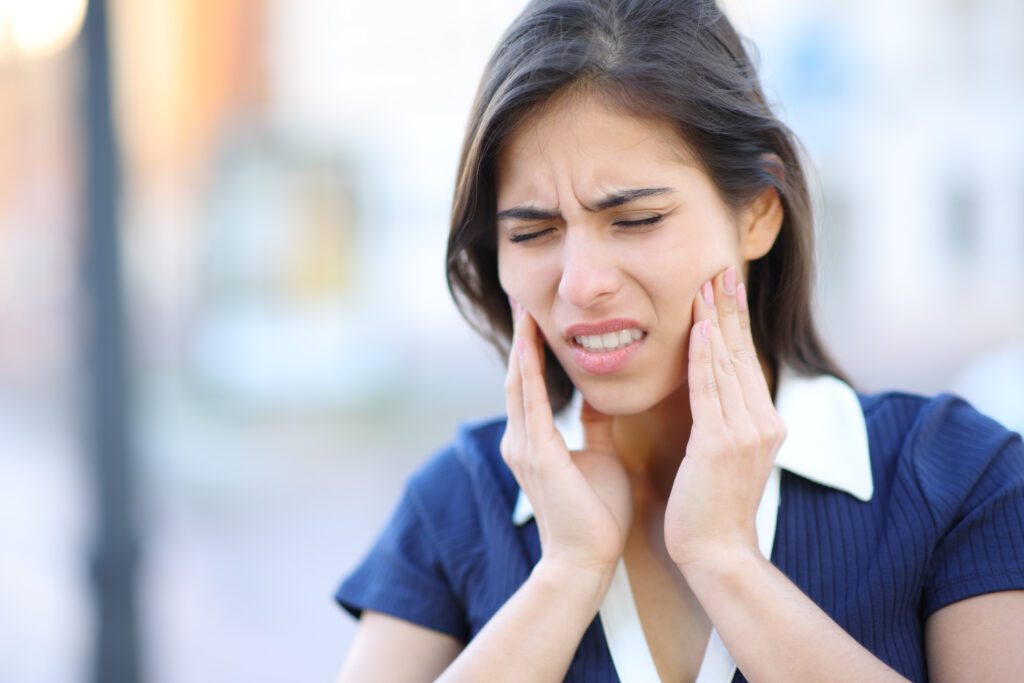
TMJ disorders can be caused by trauma (such as in a hard fall or vehicle accident), an improper bite, arthritis or wear and tear of teeth over the years. Common symptoms include jaw tenderness, headaches, earaches and facial pain.
I am a Fellow of the Las Vegas Institute for Advanced Dental Studies (LVI), where my training included the bite and the jaw joints.
Typical Symptoms of TMJ Disorder Include:
- Frequent headaches or migraines
- Painful jaw joints
- Pain in the face, neck, and shoulders
- Face or neck pain
- Uncomfortable, uneven or painful bite and inability to chew
- Chipped, worn or broken teeth
- Grinding or clenching
- Clicking or popping jaw
- Ringing ears or vertigo (dizziness)
- Difficulty opening and closing the mouth
- Tingling hands
How Your Bite Relates to TMJ Problems
Bite alignment is one part of how the jaw, muscles and joints work together. A misaligned bite can strain the jaw joints while chewing, speaking and even resting. Over time, this strain can lead to problems.
Dr. Barbat looks at how your teeth, jaw muscles and joints work together, and she considers your bite when planning dental treatment.
Accurate Diagnosis Through Advanced Technology
The key to treating TMJ disorder properly is finding the precise point that is causing it. For example, if it is coming from a misaligned bite, exactly where in the bite is the imbalance? Computerized measurements of your bite and jaw movement help Dr. Barbat find where the problem may be coming from and plan conservative care.
Advanced Tools for TMJ Diagnosis
- Biopak System: Records the functions and congruity of the upper and lower jaw, jaw joints, and associated muscles at various ranges.
- Tekscan (T-Scan™): Provides an efficient digital occlusal analysis. The readouts show where bite contact is made as well as when and with how much force, including the timing of occlusal surfaces coming together.
TMJ Treatment Options
Once the pain’s source is known, treatment may be surprisingly conservative. In some cases, the reshaping of certain teeth or replacing of one or more crowns may help. In more extreme cases, treatment may involve one or more options to resolve the TMJ-related issues.
“When they have a question, we stop. … I want everyone to know we really listen.”
Dr. Ban R. Barbat
Schedule a TMJ Consultation
If you feel you have TMJ disorder, we encourage you to start with an accurate diagnosis. This way, we can look for the source of your discomfort and talk with you about your options. Begin with a $58 TMJ consultation to discuss your individual situation and what may be involved for diagnosis. If you proceed, your $58 is credited toward your comprehensive evaluation.
To schedule a consultation, call 586-739-2155 or tap here for an online request.
At-Home Relief Tips for TMJ Pain
In the meantime, you may be able to lessen the symptoms of TMJ pain through some at-home measures, such as:
- Apply moist heat or cold packs to the side of the face and temple area for about 10 minutes. Soothing heat can be applied using a warm towel or washcloth.
- Adjust your diet with mostly soft foods to prevent jaws from chewing stress. Avoid chewing gum.
- Take OTC non-steroidal anti-inflammatory drugs (NSAIDs), such as aspirin, ibuprofen (Advil®, Motrin®) or naproxen (Aleve®). Muscle relaxants can also help relax tight jaw muscles.
- Wear a night guard that is custom-made for your bite to keep your jaw in a more favorable position.
- Avoid or limit jaw movements that can overwork the jaw joints, such as yawning, resting your chin on your hand, or holding the phone between your shoulder and ear.
- Practice good posture to reduce neck and facial pain.
- Keep your teeth slightly apart as often as you can to relieve pressure on the jaw.
- Try relaxation techniques to help control muscle tension in the jaw.
Learn More About Our Advanced Technology
If you’d like to get to know our office and its advanced features for complete dental care, please view: Watch on YouTube.
Dr. Ban R. Barbat is a general dentist and the founder of our practice. She has served Shelby Township since 1997.